Our International Church Partnership
Our International Church Partnership is an important part of our life at Purley United Reformed Church. Through friendship, shared worship, and mutual support, we connect with a sister church beyond the UK, strengthening our sense of global Christian community. This partnership helps us learn from one another, celebrate our different traditions, and work together in faith. It reminds us that the Church is bigger than any one place — and that we are called to walk alongside our neighbours across the world.
What Is It About
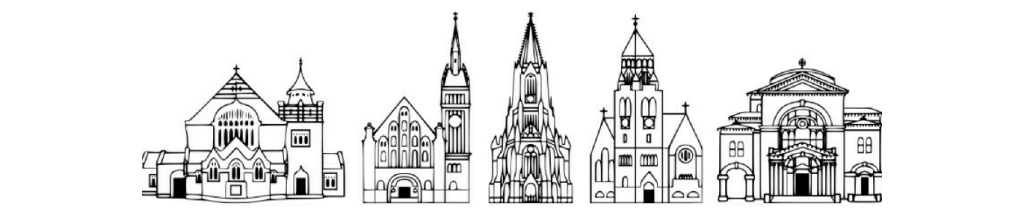
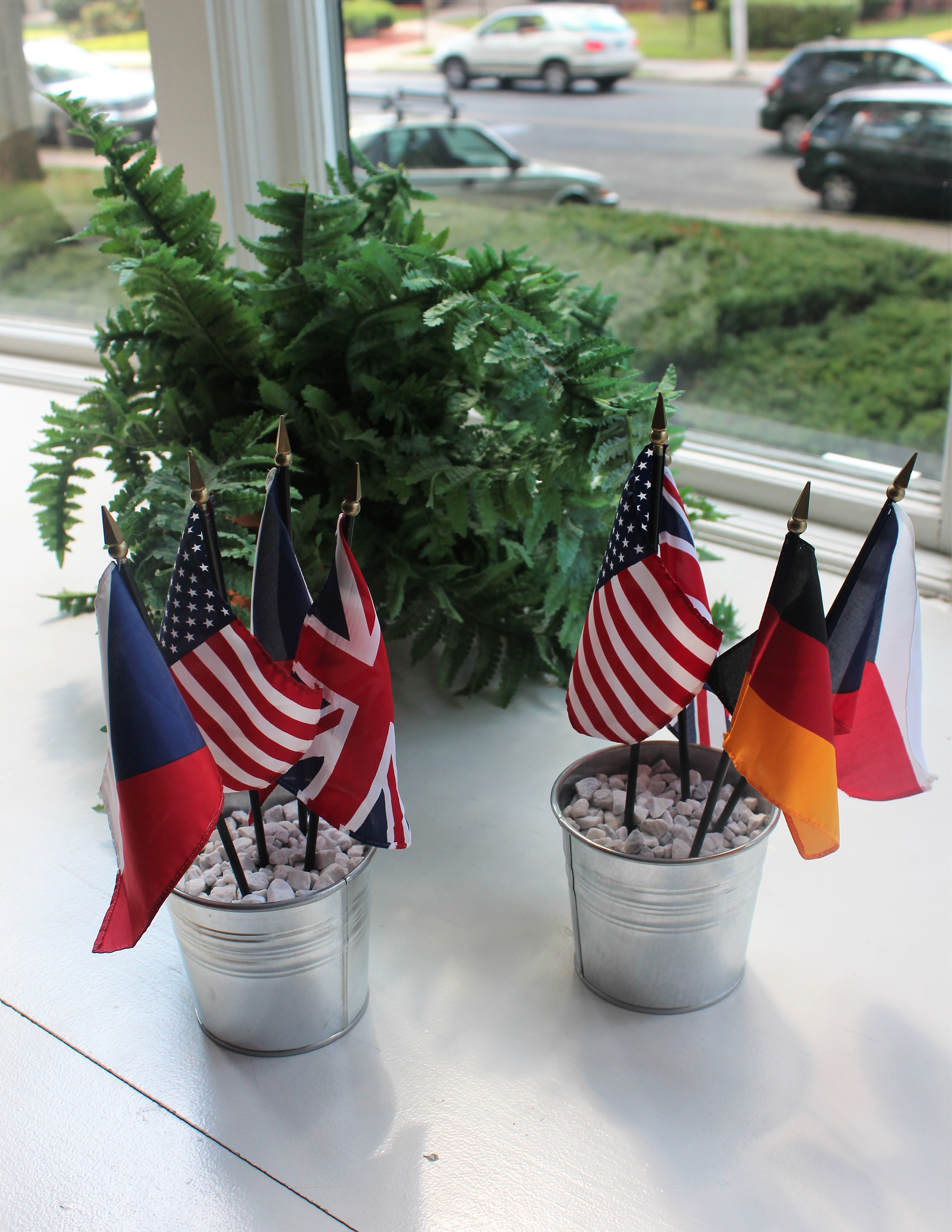
Our International Church Partnership is, we believe, unique. It brings together five congregations of the Reformed tradition and has now lasted for some 50 years. During that time, numerous people have been involved in shared worship, in conferences and other events, in informal visits and in prayer for one another and our situations: and the friendships that have been formed and the experiences that have been shared have been in some cases literally life changing.
The Five Partnership Churches
Českobratrské církve evangelické – CCE, Ostrava
Petruskirche, Dessau
Gedächtniskirche, Speyer
Purley United Reformed Church
Immanuel Congregational Church, Hartford
History of Partnership
Since the mid-1960s, the word “Partnership” has had special significance in Purley URC, as this congregation is part of what we believe to be a unique five-way linking of local churches in the reformed tradition: –
- Czech Republic – Českobratrské církve evangelické – CCE, Ostrava
- Germany – Petruskirche, Dessau (Evangelische Landeskirche Anhalts)
- Germany – Gedächtniskirche (Evangelische Kirche der Pfalz – EKP)
- United Kingdom – Purley United Reformed Church – URC)
- United States of America – Immanuel Congregational Church, Hartford, Connecticut (United Churches of Christ – UCC)
The Partnership has been an important part of Purley URC’s life for over 55 years, giving opportunities for members and friends of the congregation to learn at first-hand about the lives of fellow Christians in other countries and to understand more about the challenges and issues they face locally – often very similar, especially on societal issues. It is also notable for the depth, breadth and diversity of personal friendships which have developed, sometimes over multiple generations of the same family. It provides many openings for dialogue and the sharing of experiences across national boundaries that do much to break down stereotypes and prejudices and helps to foster a better understanding of the world in which we live.
What is the Partnership and how has it developed?
Post-war roots
The Partnership has its roots in contacts begun shortly after the Second World War at grass roots level and aimed at opening channels for reconciliation between local congregations in England and the Palatinate (Federal Republic of Germany). A first visit by three young people from Shelley Road Congregational Church in Worthing to Wolfstein in the Palatinate took place in August 1949.
Early links with Germany & Czech Republic
In 1957 a “Communion of Pulpit and Lord’s Table” was signed between the then Congregational Church in England and the Evangelische Kirche der Pfalz (EKP). Arising indirectly out of that, Purley’s first link, with the Gedächtniskirche in Speyer, was established in 1967.
In the meantime, links had been established after the partition of Germany between churches in the former Federal Republic (West Germany) and Democratic Republic (East Germany). This led to Purley’s connections with the Petruskirche, Dessau and, indirectly, the Ostrava congregation of the Evangelical Church of the Czech Brethren (CCE).
Private visits during the Cold War
Early contact with these two churches was limited by the political situation mainly to exchanges of letters between individuals, although a number of people from Purley paid private visits to both East Germany and Czechoslovakia during the 1970s and the 1980s. A few people from Dessau were permitted to attend Partnership conferences from 1980 onwards. All that changed, however, after the momentous events of autumn 1989 and the fall of the Berlin Wall.
Changes after 1989
July/August 1992 saw an undoubted high point in the Partnership story: a two‑week conference in Purley, attended by about 120 visitors, of whom nearly half came from Dessau and Ostrava. The BBC recorded parts of it for ‘Songs of Praise’, and the broadcast later that year generated a remarkable number of letters and comments, including some from as far away as Australia.
The 1992 Purley Conference / Gathering
The 1992 Purley conference was a landmark event, bringing together large numbers of participants from all partner churches. It strengthened friendships, deepened understanding, and marked a new era of openness and shared experience following the political changes in Europe.
Link with Woodvale Presbyterian Churches Here
From the early 1980s, Purley also maintained an informal link with Woodvale Presbyterian Church, Belfast. This enabled people to gain insights into the Northern Ireland situation which were greatly valued in the Partnership as a whole; and a few Woodvale members became regular conference participants. Mainly, however, contacts until about 2011 were through correspondence and bilateral annual visits, in which a few members from other Partnership churches sometimes took part. More recently, there were hopes that friendships between young people in each congregation would help to maintain the link: but these seem now to have failed.
How is the Partnership sustained?
- In 2016, at a conference in Ostrava, the five churches signed a ‘Declaration of an International Church Partnership’ which underpins all that takes place, whether within each individual congregation or collectively. It commits us all to
- Shared worship on the last Sunday in January, prepared in turn by each church. We all use the same elements of worship – a reading, a letter (in the spirit of an epistle and including faith-based reflections on the situation in that congregation) and prayers of intercession.
- Prayers for peace on the first Sunday in September, again prepared in turn by each church. The date marks the anniversary of the outbreak of the Second World War and reminds us all of the Partnership’s origins in seeking reconciliation in Europe following that war. (The candle lit at the start of morning worship in Purley is a further symbol of these origins: the first candle used was a gift from Dessau – significantly, in 1989, shortly before the fall of the Berlin Wall.)
- Mutual support by prayer for all our congregations and for individuals within them.
- A three-yearly conference, hosted in turn by each congregation.
- Informal small-scale visits (e.g. special occasions, holidays, business trips, youth meetings). These happen on an intermittent basis, and visitors try to ensure that their stay in the partner congregation includes a Sunday, so helping them to meet a wide range of members and friends.
- Regular sharing of greetings, newsletters and ad hoc news of individuals, including links between websites.
- Most recently, a developing programme of Zoom sessions, quarterly for the lay conveners in each congregation, and half-yearly for all.
Key Partnership Gatherings and Milestones
Timeline Item: 1971 — Cycle Begins
The cycle of gatherings which began in 1971 has continued to be the most high‑profile mark of Partnership. They are planned and hosted in turn by one of the five congregations, and now usually last for around a week during school summer holidays. The programme generally includes talks and/or discussions, worship and Bible studies, social times and outings. Participants generally stay with families from the host church, although since 2016 the reduced availability of host families has led to the use of local hostels, guide/scout centres etc. to accommodate younger participants – a very successful innovation which has helped to cement friendships among a new generation of participants. Many visitors also use the opportunity to add on some holiday in the host country as well.
Timeline Item: 2015 — First Youth Week (Speyer)
2015 saw the first ‘Youth Week’ in Speyer.
Timeline Item: 2016 — Ostrava Conference (Semper Reformanda)
This cycle of conferences continued until 2016, when Ostrava hosted an event with the theme Semper Reformanda (‘Always reforming’) – a nod to the fact that all our five congregations belong to the Reformed tradition.
Timeline Item: 2018 — Youth Week in Purley
In 2018 Purley hosted a second Youth Week: at present there are no plans for a further one.
Timeline Item: 2019 — Dessau Unable to Host
Local issues in Dessau meant they were unable to invite the partner churches to meet there in 2019.
Timeline Item: 2023 — Purley Hosts “Treasure – Creation, Justice, Partnership”
It was 2023 before the five churches could meet again, this time in Purley: the theme was ‘Treasure – Creation, Justice, Partnership’, and the week was a much‑valued opportunity for friends new and old to meet and catch up after a 7‑year gap.
Timeline Item: 2026 — Speyer Gathering Takes Place
The gathering planned for Speyer has now taken place. A group from Purley United Reformed Church joined friends from the partner congregations for the event in July/August 2026. The week continued the long tradition of shared worship, discussion, fellowship and international friendship that has characterised the Partnership for over fifty years.
The Future of Partnership
Following the deferment of the Purley event, Speyer will be the host church for the next one, and a group from Purley United Reformed Church will be joining others for our next gathering in July / August 2026.
In the meantime, all the other regular Partnership activities continue throughout the year, including joint worship sessions via Zoom, informal visits and other such events to mark special occasions.
Maintaining our Partnership
Day‑to‑day communication
The strength of the Partnership lies in its day‑to‑day existence. Formal and informal contacts are maintained, and the immediacy of e‑mail, Skype, Facebook and other new technology media means that news and conversations can be shared much more easily now than they were in the early days: then the communication was of course all by letter, and necessarily involved very few people. English tends to be the default language for most people, but a good number of the Purley congregation over the years have learned some German, and in some cases a little Czech.
Shared worship
Formally, the congregations share aspects of worship at least twice a year. A service at the end of January incorporates material (readings, an ‘epistle’ and prayers) prepared by each minister or congregation in turn.
Prayers for peace
On the first Sunday in September, we share in prayers for peace, again created in turn by each minister. The idea for this came from the minister of the Petruskirche in Dessau, Pfarrer Wolfgang Steckel, in the late 1980s: and it is to Dessau also that we owe the peace candle presented to each of the other congregations at the end of the conference hosted by his church in 1989. In Purley that candle is lit at the beginning of every Sunday morning service as a reminder of our commitment, through the Partnership and in other ways, to peace and reconciliation.
Three‑yearly conferences
Since 1971 a Partnership conference has been held every three years: this is hosted in turn by the congregations, resulting in a 15‑year cycle now that all five members do so. The most recent conference took place in Ostrava in July/August 2016, and this was the occasion on which our ‘Declaration of an International Church Partnership’ was formally adopted and accepted by all the congregations.
Youth involvement
Between conferences, links are maintained through many smaller meetings and visits. Events for young people have always played their part in the Partnership, resulting in a number of lifelong friendships which see those involved in them as young people now in positions of leadership within their congregations. Purley hosted a young people’s gathering in the summer of 2018, when two of the adult leaders were people who met as teenagers at a Partnership youth event in Germany.
Informal visits
The depth of friendships means that informal visits happen regularly. Invitations are issued for special anniversaries, birthdays, inductions and other occasions: and over and above this, it is generally understood that anyone visiting in the area of one of the partner churches can always be assured of hospitality and accommodation. Given its proximity to London, that certainly happens a good deal in Purley!
Mutual support in prayer
All these links are underpinned by the mutual support offered in prayer, whether on occasions of sadness or joy, and whether individual or wider. Messages of support and concern are sent and shared on occasions of wider concern.
Declaration of an International Church Partnership between:
Petrusgemeinde, Dessau (Evangelische Landeskirche Anhalts)
Immanuel Congregational Church, Hartford, Connecticut (United Church of Christ)
Českobratrská církev evangelická, Ostrava
Purley United Reformed Church
Gedächtniskirchengemeinde, Speyer (Evangelische Kirche der Pfalz)
“May they all be one…” – John 17 v.21
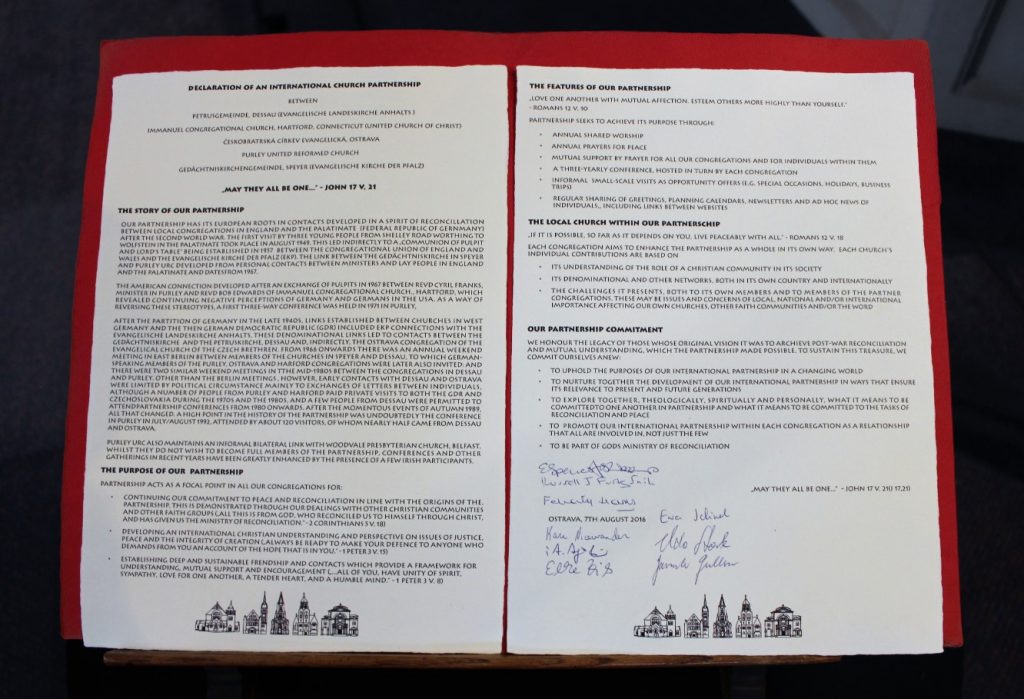
The Story of our Partnership
Our Partnership has its European roots in contacts developed in a spirit of reconciliation between local congregations in England and the Palatinate (Federal Republic of Germany) after the Second World War. The first visit by three young people from Shelley Road Worthing to Wolfstein in the Palatinate took place in August 1949. This led indirectly to a “Communion of Pulpit and Lord’s Table” being established in 1957 between the Congregational Union of England and Wales and the Evangelische Kirche der Pfalz (EKP). The link between the Gedächtniskirche in Speyer and Purley URC developed from personal contacts between ministers and lay people in England and the Palatinate and dates from 1967.
The American connection developed after an exchange of pulpits in 1967 between Revd Cyril Franks, minister in Purley, and Revd Bob Edwards of Immanuel Congregational Church, Hartford, which revealed continuing negative perceptions of Germany and Germans in the USA. As a way of reversing these stereotypes, a first three‑way conference was held in 1971 in Purley.
After the partition of Germany in the late 1940s, links established between churches in West Germany and the then German Democratic Republic (GDR) included EKP connections with the Evangelische Landeskirche Anhalts. These denominational links led to contacts between the Gedächtniskirche and the Petruskirche, Dessau and, indirectly, the Ostrava congregation of the Evangelical Church of the Czech Brethren.
From 1966 onwards there was an annual weekend meeting in East Berlin between members of the churches in Speyer and Dessau, to which German‑speaking members of the Purley, Ostrava and Hartford congregations were later also invited; and there were two similar weekend meetings in the mid‑1980s between the congregations in Dessau and Purley.
Other than the Berlin meetings, however, early contacts with Dessau and Ostrava were limited by political circumstance mainly to exchanges of letters between individuals, although a number of people from Purley and Hartford paid private visits to both the GDR and Czechoslovakia during the 1970s and the 1980s, and a few people from Dessau were permitted to attend Partnership conferences from 1980 onwards.
After the momentous events of autumn 1989, all that changed. A high point in the history of the Partnership was undoubtedly the conference in Purley in July/August 1992, attended by about 120 visitors, of whom nearly half came from Dessau and Ostrava.
Purley URC also maintains an informal bilateral link with Woodvale Presbyterian Church, Belfast. Whilst they do not wish to become full members of the Partnership, conferences and other gatherings in recent years have been greatly enhanced by the presence of a few Irish participants.
The Purpose of our Partnership
Partnership acts as a focal point in all our congregations for:
Continuing our commitment to peace and reconciliation in line with the origins of the Partnership. This is demonstrated through our dealings with other Christian communities and other faith groups (“All this is from God, who reconciled us to himself through Christ, and has given us the ministry of reconciliation.”- 2 Corinthians 5 v.18).
Developing an international Christian understanding and perspective on issues of justice, peace and the integrity of creation (“Always be ready to make your defence to anyone who demands from you an account of the hope that is in you.” – 1 Peter 3 v.15)
Establishing deep and sustainable friendships and contacts which provide a framework for understanding, mutual support and encouragement (“…all of you, have unity of spirit, sympathy, love for one another, a tender heart, and a humble mind.” – 1 Peter 3 v.8 )
The Features of our Partnership
“Love one another with mutual affection. Esteem others more highly than yourself.”- Romans 12 v.10
Partnership seeks to achieve its purpose through:
- Annual shared worship
- Annual prayers for peace
- Mutual support by prayer for all our congregations and for individuals within them
- A three-yearly conference, hosted in turn by each congregation
- Informal small-scale visits as opportunity offers (e.g. special occasions, holidays, business trips)
- Regular sharing of greetings, planning calendars, newsletters and ad hoc news of individuals, including links between websites
The Local Church within our Partnership
“If it is possible, so far as it depends on you, live peaceably with all.”- Romans 12 v.18
Each congregation aims to enhance the Partnership as a whole in its own way. Each church’s individual contributions are based on Its understanding of the role of a Christian community in its society
Its denominational and other networks, both in its own country and internationally.
The challenges it presents, both to its own members and to members of the partner congregations. These may be issues and concerns of local, national and/or international importance affecting our own churches, other faith communities and/or the world.
Our Partnership Commitment
We honour the legacy of those whose original vision it was to achieve post-war reconciliation and mutual understanding, which the Partnership made possible. To sustain this treasure, we commit ourselves anew:
to uphold the purposes of our International Partnership in a changing world to nurture together the development of our International Partnership in ways that ensure its relevance to present and future generations
to explore together, theologically, spiritually and personally, what it means to be committed to one another in Partnership and what it means to be committed to the tasks of reconciliation and peace
to promote our International Partnership within each congregation as a relationship that all are involved in, not just the few to be part of God’s ministry of reconciliation.
“May they all be one…” – John 17 v.21